




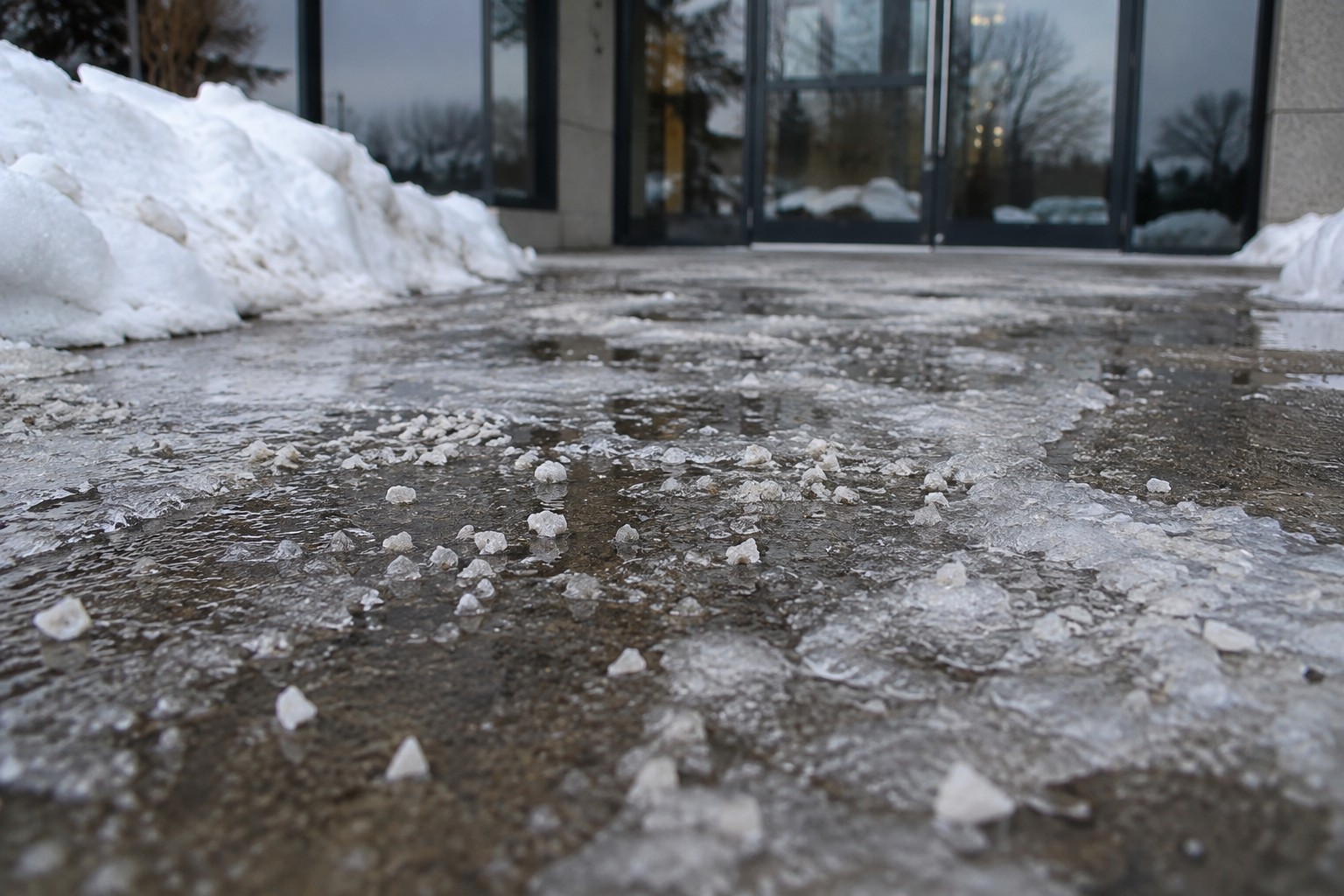
Ice is the part of a Twin Cities winter that often catches commercial properties off guard. Plowing is visible and easy to measure. Ice is quieter. It forms overnight in a shaded entry alcove, in the low corner of a lot where meltwater collects, and on the walk under a roofline that drips every afternoon in the sun. By the time anyone notices, the surface is already slick and the morning rush is thirty minutes away.
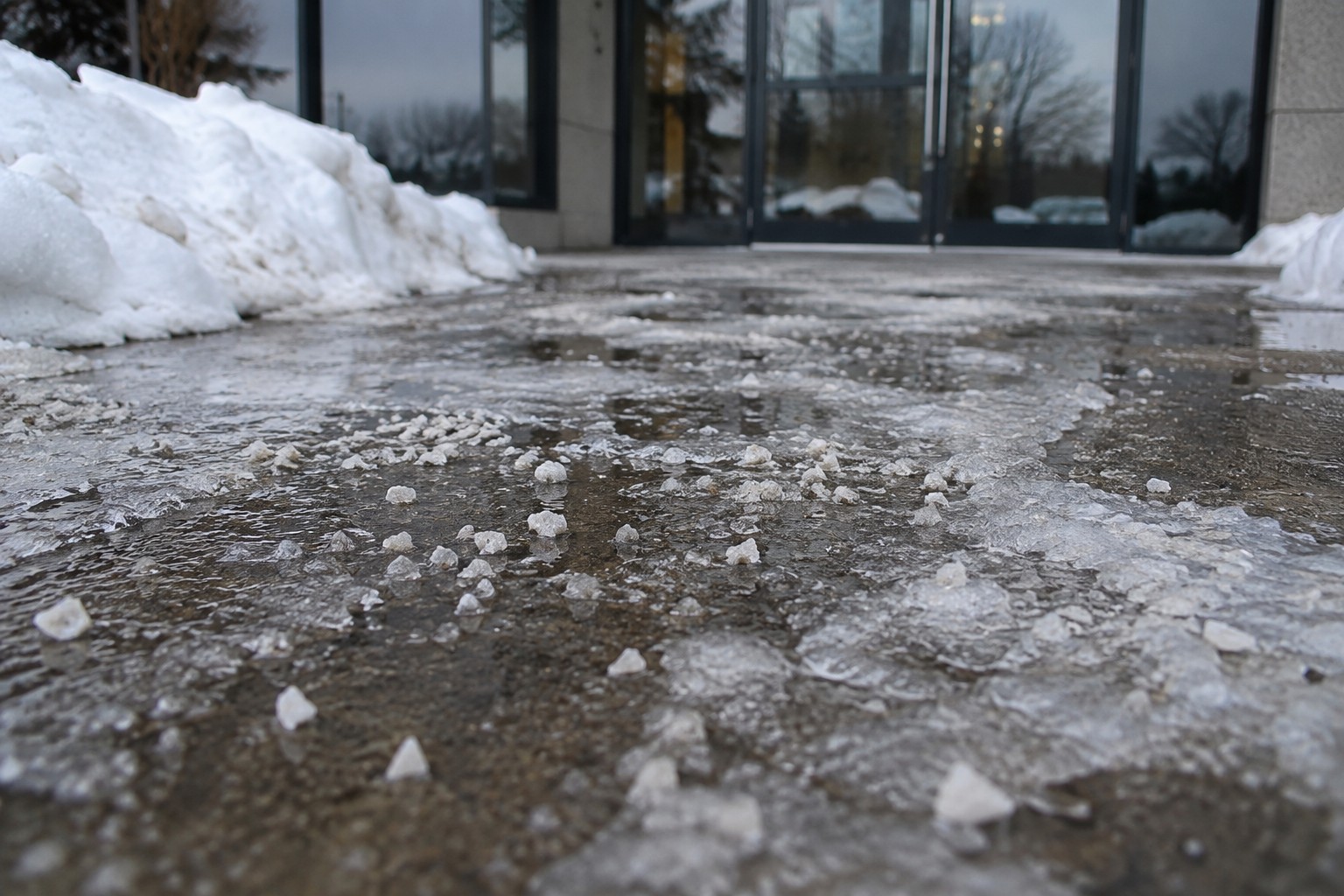
This guide explains how commercial ice management actually works on Minneapolis and Twin Cities properties: what gets applied, when it gets applied, why timing beats volume, and what a property manager should expect from a contractor over a full season. It is written for people who manage office parks, retail centers, medical buildings, industrial sites and multi-tenant properties across the metro.
What is commercial ice management?
Ice management is the treatment side of winter services. Snow removal moves accumulation off the surface. Ice management keeps the surface that is left behind from refreezing, and treats the ice that forms without any snowfall at all.
On a commercial property it usually covers four things:
- Pre-treatment before a storm or a freeze event, so the bond between ice and pavement never fully forms.
- Post-plow treatment of cleared drive lanes, parking areas, walks and entries once the snow is off.
- Refreeze response during melt and freeze cycles, which in the Twin Cities run from late October through early April.
- Problem-area management: the shaded corners, downspout outfalls, loading docks and ramp bases that ice up when the rest of the site is dry.
The last item is where many slip complaints come from. A site can be plowed perfectly and still have three spots that are dangerous every single morning.
Why does ice form on a property that was already plowed?
Because plowing leaves a thin film behind, and because the Twin Cities spend most of the winter moving back and forth across the freezing point.
Three patterns cause most of it:
Melt and refreeze. Daytime sun warms dark pavement above freezing even when the air is cold. Snow piles and roof snow melt, water runs across the lot, and at dusk it refreezes as a sheet. This is the most common cause of early morning ice on a well plowed property.
Compacted snowpack. Traffic over a thin layer of leftover snow turns it into a hard, polished layer that a plow blade rides straight over. Once it bonds to the pavement it has to be broken chemically or mechanically, which costs far more time than preventing it would have.
Drainage that sends water the wrong way. A settled area in a lot, a clogged or failing catch basin, a downspout discharging across a walkway: each one puts water where people walk and then freezes it. Ice in the same spot every winter is almost always a drainage problem wearing a winter costume. A fall review of the site's catch basins and drainage structures removes a surprising number of recurring ice complaints.
What materials are used for de-icing, and how do they differ?
Most Twin Cities commercial properties use a small set of materials, chosen by temperature and by what is under and around the surface.
| Material | Typical working range | Best use on a commercial site | Things to watch |
|---|---|---|---|
| Rock salt (sodium chloride) | Roughly 15 to 20 degrees F and above | Open parking areas and drive lanes during and after a normal storm | Loses effectiveness as temperatures drop, and over-application wastes material without improving results |
| Treated salt (salt blended with a liquid) | Works lower than untreated salt | Colder events and overnight applications | Needs correct spreader calibration to pay off |
| Liquid brine | Pre-treatment before a storm or freeze | Walks, entries, ramps and lots ahead of a forecast event | Applied before precipitation starts, not during heavy rain or sleet |
| Calcium chloride and magnesium chloride blends | Well below the practical range of plain salt | Deep cold events, stubborn ice, shaded problem areas | Higher material cost, so it is used where it is needed rather than site wide |
| Sand | Any temperature | Traction on ice that will not melt in extreme cold | Provides grip, does not melt anything, and needs spring cleanup |
The useful takeaway for a property manager is this: more salt is not better service. The right question is whether the contractor is matching material to pavement temperature and applying it at the right moment. A pre-treatment that prevents a bond uses less material than a response that has to break one.
What is pre-treatment, and does it actually help?
Pre-treatment means putting material down before frozen precipitation arrives, usually as liquid brine, so there is a film on the pavement when the first flakes land. Snow and ice then sit on top of that film instead of freezing directly to the surface.
Two things follow from that. Clearing is faster and cleaner, because the layer breaks free instead of welding itself to the pavement. And the surface that is left after clearing refreezes more slowly, which matters most on walks and entries where people step out of a warm building onto cold concrete.
Pre-treatment is not always the right call. Rain ahead of a freeze washes material off, so it is wasted. Very warm pavement does the same. A contractor who pre-treats every event regardless of the forecast is not reading the weather, and a contractor who never pre-treats is leaving one of the easiest wins on the table.
How often should a commercial property be treated during the winter?
There is no fixed number, because the Twin Cities do not deliver a fixed winter. What is predictable is the shape of the season.
- Late October through November. Frost events, first flurries and black ice on untreated walks. Often few plow events, but real ice risk, especially at entries.
- December through February. The core plow season, with deep cold stretches where plain salt stops doing much and blends or sand carry the load.
- Late February through April. The heaviest melt and refreeze window of the year. Large snow piles release water across lots all afternoon and it freezes every night. More slip complaints come out of this window than most managers expect.
A reasonable expectation is that treatment is driven by conditions, not by a calendar, and that the contractor can tell you after the fact what was applied, where, and when.
Which parts of a commercial property need the most attention?
Ice does not distribute itself evenly. These are the areas that generate the most trouble on Twin Cities commercial sites.
- Building entrances and the first ten feet of walkway. Highest foot traffic, highest exposure, usually in the shade of the building for part of the day.
- Accessible parking stalls and access aisles. These must stay clear and treated, and they are often adjacent to where snow gets pushed.
- Ramps, stairs and transitions. Changes in grade are where a loss of traction can become a fall.
- Loading docks and service entries. Heavy traffic, often cleared later in the sequence, and frequently in shadow.
- Low spots and drainage paths. Wherever meltwater collects, and wherever it crosses a walk.
- Downstream of snow storage. Snow piles melt onto whatever is below them, and that surface is the first to glaze over at night.
Walking these six areas once at the start of the season, with the contractor present, resolves more winter problems than any mid-season conversation will.
How should snow storage be planned so it does not create ice?
Where snow is stacked determines where water goes for the next several months. Good practice on a commercial site is to stack snow downhill of the main drive lanes and away from entries, keep piles off accessible stalls and fire lanes, keep sight lines at exits clear, and avoid stacking directly over catch basins or on top of landscape beds and irrigation heads.
Get this wrong and the property may pay twice: ice across the lot all winter, and turf, curb or irrigation damage to repair in spring.
What should ice management look like in a service agreement?
Ice service is where winter agreements differ most from one another, so it is worth reading closely before the season starts. Useful things to confirm:
- What triggers a treatment visit, and whether ice-only events are covered or billed separately from plow events.
- Which surfaces are included: lots, drive lanes, walks, entries, stairs and docks are not always all in the primary scope.
- What the response expectation is overnight and on weekends.
- Whether pre-treatment is included or added per event.
- How service is documented, and whether you receive timestamped records of what happened on your site.
- Who you contact during an event, and how fast that contact answers at two in the morning.
Documentation matters more than most managers expect. Being able to show what was applied and when, for your own records and for your ownership group, is one of the clearest differences between a professional winter program and/or not. More detail on structuring the agreement itself is in our guide to commercial snow plowing contracts.
How do you tell a strong ice management contractor from a weak one?
Ask four questions.
How do you decide what to apply? You want an answer about pavement temperature, forecast and event type, not a single default material used all winter.
What do you do about the spots that ice up every year? A strong contractor already knows which key areas on your site are the problem, and has a plan for them that includes fixing the cause, not only treating the symptom.
What happens overnight and before six in the morning? Commercial ice risk should be resolved before tenants arrive.
What will I be able to see afterward? Service records, site notes and a contact who responds promptly provide you with the peace of mind you are looking for.
If the property has multiple buildings or multiple sites, consistency across them becomes its own issue. Our guide on vetting a snow removal vendor for a multi-site portfolio covers that in detail.
Does ice management connect to the rest of the property's maintenance?
More than it looks. Recurring ice in the same spot usually points to grading or drainage. Salt-heavy areas show up in spring as turf damage along curb lines and as surface wear on concrete walks. Snow piles stacked in the wrong place crush shrubs and break irrigation heads. A contractor who handles snow, concrete and grounds on the same property sees the whole cycle and can fix the cause in the off season.
That is one of the practical arguments for consolidating outdoor services, covered in our piece on single-vendor outdoor services for commercial properties.
Frequently asked questions
At what temperature does salt stop working on a parking lot?
Plain rock salt becomes slow and inefficient as pavement temperature drops toward the mid teens, and it is effectively unproductive below that. In deep cold, treated salt, calcium or magnesium chloride blends, or sand for traction are the practical options.
Is pre-treating a commercial lot worth it?
When the forecast supports it, yes. A brine application before a storm keeps snow and ice from bonding to the pavement, which makes clearing faster and the cleared surface slower to refreeze. It is not useful ahead of rain, or when pavement is still warm.
Why does the same corner of my property ice over every winter?
Almost always it is a result of water arriving there and standing. A downspout discharging onto the walk, a settled low spot, or a catch basin that is not draining. Treatment manages it for a season. Correcting the drainage in the warm months ends it.
Should walks and entries be treated separately from the parking lot?
In practice, yes. Walks, entries, stairs and accessible routes are concrete, heavily travelled and often shaded, so they behave differently from open asphalt and usually need their own material and their own timing. Confirm in the service agreement that they are named as their own scope rather than assumed to be covered by lot service.
How quickly should walks and entries be treated after a storm?
Entries, walks and accessible routes should be in the first pass, not the last. On most commercial properties the goal is a safe, treated entry before tenants and customers arrive, with the open lot finished around that priority.
Does sand replace salt?
No. Sand provides traction on ice but does not melt it. It is useful in extreme cold where chemical de-icers are slow, and it needs to be swept up in spring.
Planning winter on a Twin Cities commercial property
Ice management is a planning exercise more than a reactive one. The properties that come through a Minnesota winter cleanly are the ones that had a site walk in the fall, identified their problem areas, matched the service agreement to how the property is actually used, and fixed the drainage issues that create ice in the first place.
TCOS provides commercial snow and ice management across the Twin Cities metro, including pre-treatment, de-icing, snow relocation and the concrete and drainage work that prevents recurring ice. You can see the full scope on our commercial snow and ice services page.
Talk to TCOS about your property
Ready to plan the season? Contact TCOS, email [email protected] or call 763-235-2400.